
 Hikingthrough the mountains of the Sacred Valley is a must-do whilst visiting Peru.
But there are so many to choose from! Do you go with the classic touristattracting Inca Trail or look for something along a road less traveled?
Hikingthrough the mountains of the Sacred Valley is a must-do whilst visiting Peru.
But there are so many to choose from! Do you go with the classic touristattracting Inca Trail or look for something along a road less traveled?
We
offer a number of different treks so it can be a challenge to decide which one
is for you. Here is a little information about each trek to help you decide.
All of our treks come with professional and knowledgeable bi-lingual tour
guides and a chef, who will prepare food fit for a king – any dietary
requirements can be catered for at no extra cost, just alert our office team so
that they can prepare. Unlike many other tour operators, Valencia Travel Cusco
ensure that all of our porters have all the equipment that they need to be
comfortable, such as hiking boots, rain jackets etc. and the same meals as any
of the clients, which many agencies do not supply. Please check on our website
for weight limits and details about hiring extra porters for your trek. We also
have extended versions of most of our treks under the ‘Specials’ section of our
website.
Be aware: hiking at
altitude is no easy feat. It is recommended that you arrive a few days before
commencing your trip so as to adjust to the altitude. Also, bringing some form
of medication to counteract possible symptoms of altitude sickness is
suggested. Though not everyone is effected by altitude sickness, it is always
best to be prepared for it.
INCA TRAIL (classic) – Destination Machu Picchu
If
you want to stick to Incan tradition, the classic Inca Trail is for you. This
trek receives many tourists every day, but that won’t take away from your
experience – not with our restaurant quality chef and top notch tour guides.
Now, this trek may not be for the faint hearted, with a particularly tough
climb on Day 2. However, you will be rewarded with spectacular views (Day 3)
and a nice rest in the hot springs at Aguas Calientes (Day 4), not to mention
the ultimate prize that is the lost citadel of Machu Picchu (Day 4). All this
followed by a comfortable train journey back to Ollantaytambo where you will be
picked up and transported back to Cusco on a private bus.
TheInca Trail allows you to do the same trek that the Inca people walked years
ago, giving you an authentic experience of what it would have been like to hike
the trail (just with a few added luxuries). However, if you’re looking for
something a little more off-the-tourist-track, this trek is not for you.

Find the complete itinerary on our website:
Classic Inca Trail Trek to Machu Picchu - 5 Days
SALKANTAY – Destination Machu Picchu
If
you prefer to steer away from the more tourist-y areas whilst experiencing a
variety of different perspectives, the Salkantay trek is the one for you. So it
may not be the original Incan hike, but you will get to experience valleys,
jungle, cloud forests and grasslands. Again, this is not a particularly easy
trek, but is slightly easier than the Inca trail. You will enjoy lunch with
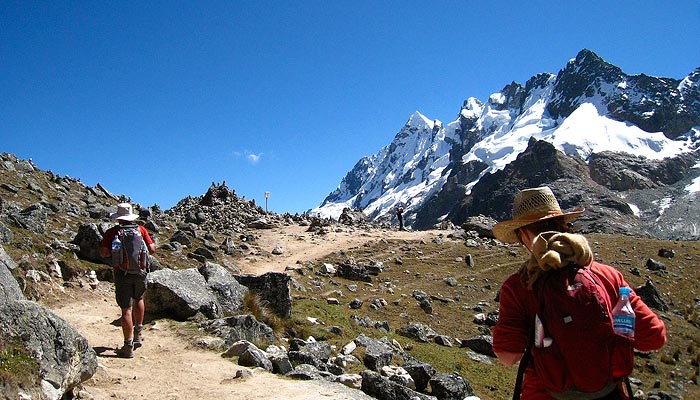
panoramic views of snow-capped mountains (Day 1), waterfalls (Day 3) and Incan
forts (Day 4), as well as the option of experiencing the relaxing waters of the
hot springs after a day of hiking (Day 3 and Day 4). All before reaching ourdestination of Machu Picchu.
This
is a beautiful and exciting alternative to the Inca Trail and allows you to see
a variety of different climates within Peru. Though please note, there is a
possibility of snow on this trek so if you’re not a fan of snow, maybe this
trek is not for you. If you do select this trek, be sure to bring some warm
clothes.
Find the full itinerary here:
Like the Salkantay trek, this is a great alternative if you want to get
off-the-beaten-track. The Lares trek takes you through the rural communities inthe mountains, allowing you to get a true insight as to what it is like to live
a traditional life in the Sacred Valley in modern times. The trek is of a
similar difficulty to Salkantay and will take you past lagoons (Day 1), small
stone villages with thatches roofs (Day 1 & 2), and the option of relaxing
in the hot springs just outside of the small town of Lares. On the third day,
you will hike to Ollantaytambo to board a train to Aguas Calientes, spending
the night there in a hotel, where you can reward yourself with a hot shower,
before heading to Machu Picchu via bus the following morning.
TheLares trek is the perfect trek for you if you are looking to experience
traditional Peruvian culture at its base, the Sacred Valley. You can learn a
little about the well-respected weaving techniques of the locals. It’s worth
noting, that many of the people that originate from these towns, make extra
money as porters, so your porters could be a valuable source of information
providing an interesting perspective on this trip. However, if you would prefer an adventure
experienced by a larger proportion of people, the Inca trail would be a better
recommendation for you.

View
the whole itinerary here:
HUCHUY QOSQO – Destination Machu Picchu
If
you’re looking for a shorter trek away from the crowds of tourists or to
experience interacting with the local people maintaining their traditions in
the Valley, this is the trek for you. The first day of the hike will take you
past lakes, mountains, grasslands and rural communities, with the goal of
reaching a traditional Andean community in the town of Qenko. As there are not
many tourists who visit the town, the locals are always extremely welcoming to
those who choose to visit their town and are as intrigued about you as you are
of them. On the second day, you will be taken to see a local family where you
will have plenty time to bond with the locals. After this, you will continue on
your trek down a trail that follows the original Inca trail through a secluded
valley filled with flowers, birds and native plants. It is later on this day
that you will be transported to Ollantaytambo to board a train to Aguas
Calientes, getting a bus the following morning to Machu Picchu.
HuchuyQosqo is perfect for those that want to experience traditional Andean culture
but with a little less hiking. Granted, the hike is not super easy, but is by
no means the most difficult we offer, and there is a lot less of it. Though,
for those more experienced hikers looking for more of a challenge, I would take
a look at some of our other treks (perhaps Ausangate).

You
can view the complete itinerary here:
AUSANGATE – Destination Phinaya
This
trek is perfect for those experienced hikers or those looking for a challenge.
The 7 day Ausangate trek takes you through snow-capped mountains, past lagoons,
hot springs, and beautiful Andean villages. You will spend time with local
children in the schools (Day 2) before heading out on the trek of a lifetime.
Your campsites will expose you to stunning mountainous panoramic views, to
beautiful lagoons and lakes, and to tonnes of bio-diversity. The final day will
be spent with a final hike in the morning, spending the day in a small Andean
community, where the only vehicles are horses and bicycles.
The Ausangate trek is great for
anyone who wants to get away from the touristic side of Peru and experience
authentic Andean culture. Although, due to its length and intensity, it is
recommended that you have some basic fitness or experience hiking. The standard
Ausangate trail does not go to Machu Picchu, however, there is an option to add
Machu Picchu under the ‘Specials’ section of our website.
You
can view the full itinerary here:
Ausangate, Rainbow Mountain to Machu Picchu - 7 Days CHOQUEQUIRAO – Destination Choquequirao ruins
The Choquequirao trek is a great alternative for thosethat want to avoid the busyness of Machu Picchu. The abandoned city has many
similarities to Machu Picchu, but aside from that, very little is known about
it. During your 4 day trek, you will see a colourful variety of plant-life and
birds and will be able to enjoy all in the warm sunshine. On a clear night, the
campsite on Day 2 of the trek, close to the lost city, can sport an impressive
and photograph worthy sunset, with the possibility of spotting some condors
soaring overhead. The next morning, you will be taken on a guided tour of the
lost city of Choquequirao. With only 25% of the site having been explored,
there are many secrets still hidden in this mysterious place. On the final day,
you will ascend the other side of the valley for one final view of
Choquequirao, before heading back to Cusco by bus.
This trek is the perfect choice
for those who enjoy birds and all things nature, as well as those looking for
some Andean mystery. However, if you have your heart set on a trip to Machu
Picchu, this is not the trek for you.

To view the whole itinerary, see here:


